Most option handling is like it was before; the last /debug: option
takes effect.

However, the options /debug:dwarf or /debug:symtab don't reset all flags
into the specific behaviour they chose before - e.g. if an earlier
option enables writing a PDB, a later /debug:dwarf or /debug:symtab
doesn't disable that. This allows combining these options with options
for controlling PDB writing, for finetuning what is done.
Don't treat the options as unique enum items, but more as flags that can
be composed, like the /opt: options.

This still only processes the last option on the command line though, so
the behaviour should still remain exactly as it was, in all corner
cases.
This shouldn't have any user visible effect, but makes the logic within
the linker implementation more explicit.

Note how DWARF debug info sections were retained even if enabling a link
with PDB info only; that behaviour is preserved.
After #71433, lld-link is able to always generate build id even when PDB
is not generated.

This adds the `__buildid` symbol to points to the start of 16 bytes guid
(which is after `RSDS`) and allows profile runtime to access it and dump
it to raw profile.
[RFC](https://discourse.llvm.org/t/rfc-add-build-id-flag-to-lld-link/74661)

Before, lld-link only generate the debug directory containing guid when
generating PDB with the hash of PDB content.

With this change, lld-link can generate the debug directory when only
`/build-id` is given:
1. If generating PDB, `/build-id` is ignored. Same behaviour as before.
2. Not generating PDB, using hash of the binary.
   - Not under MinGW, the debug directory is still in `.rdata` section.
   - Under MinGW, place the debug directory into new `.buildid` section.
ARM64EC needs to handle both ARM and x86_64 exception tables. This is
achieved by separating their chunks and sorting them separately.
EXCEPTION_TABLE directory references x86_64 variant, while ARM variant
is exposed using CHPE metadata, which references
__arm64x_extra_rfe_table and __arm64x_extra_rfe_table_size symbols.
This is necessary if the object file containing _tls_used is built with
-fdata-sections; if this symbol is present, lld is going to include
references to it in the PE header, in the TLS_TABLE data directory.

Therefore, treat the symbol as a GC root, i.e. retain it (and whatever
other symbols the section chunk references) when doing doing GC
(/opt:ref), if the symbol is present.
In mingw mode, all linker paths are passed explicitly to the linker
by the compiler driver. Don't try to implicitly add linker paths
from the LIB environment variable or by detecting an MSVC
installation directory.

If the /winsysroot command line parameter is explicitly passed to
lld-link while /lldmingw is specified, it could be considered reasonable
to actually include those paths. However, modifying the code to
handle only the /winsysroot case but not the other ones, when the
mingw mode has been enabled, seems like much more code complexity
for a mostly hypothetical case.

Add a test for this when case when using LIB. (The code paths for
trying to detect an MSVC installation aren't really regression tested.)

Also fix an issue in the existing test for "Check that when /winsysroot
is specified, %LIB% is ignored.", where the LIB variable pointed
to a nonexistent directory, so the test would pass even if /winsysroot
wouldn't be specified.

Reland this after https://github.com/llvm/llvm-project/pull/68077 and
https://github.com/llvm/llvm-project/pull/69781 - the compiler-rt test
that used -lldmingw in MSVC environments has been updated to use a more
specific option.

Differential Revision: https://reviews.llvm.org/D144084
The MinGW mode (enabled with the flag -lldmingw) does allow duplicate
weak symbols. A test in
compiler-rt/test/profile/Windows/coverage-weak-lld.cpp does currently
enable the -lldmingw flag in an MSVC context, in order to deal with
duplicate weak symbols.

Add a new, separate, lld specific flag for enabling this. In MinGW mode,
this is enabled by default, otherwise it is disabled.

This allows making the MinGW mode more restrictive in adding libpaths
from the surrounding environment; in MinGW mode, all libpaths are passed
explicitly by the compiler driver to the linker, which is attempted in
https://reviews.llvm.org/D144084.
Note that llvm::support::endianness has been renamed to
llvm::endianness while becoming an enum class as opposed to an
enum. This patch replaces support::{big,little,native} with
llvm::endianness::{big,little,native}.
This adds support for generating Chrome-tracing .json profile traces in
the LLD COFF driver.
Also add the necessary time scopes, so that the profile trace shows in
great detail which tasks are executed.
As an example, this is what we see when linking a Unreal Engine
executable:
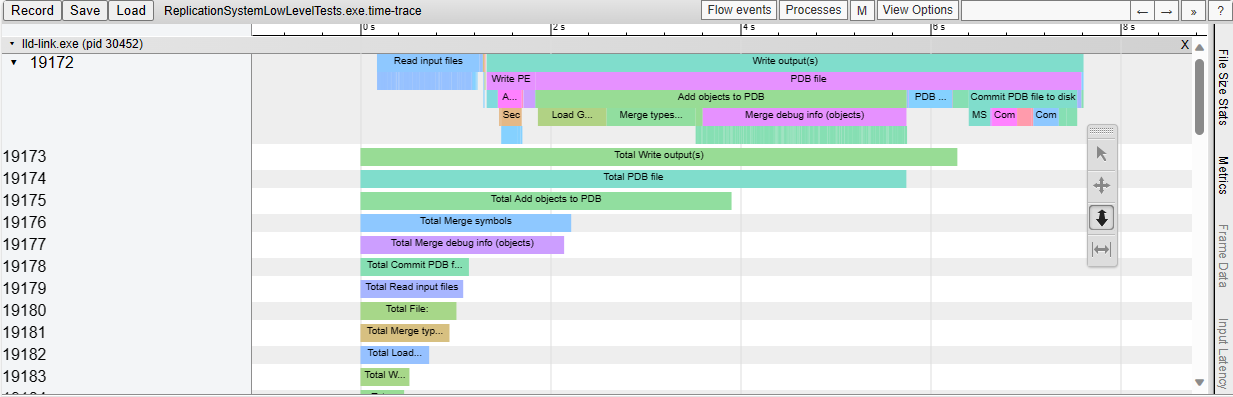
Before af744f0b84, the first entry
among the search paths was the empty string, indicating searching
in (or starting from) the current directory. After
af744f0b84, the toolchain/clang
specific lib directories were added at the head of the search path.
This would cause lookups of literal file names or relative paths
to match paths in the toolchain, if there are coincidental files
with similar names there, even if they would be find in the current
directory as well.
Change addClangLibSearchPaths to append to the list like all other
operations on searchPaths - but move the invocation of the
function to the right place in the sequence.
This fixes#67779.
We want lld-link to automatically find compiler-rt's and
libc++ when it's in the same directory as the rest of the
toolchain. This is because on Windows linking isn't done
via the clang driver - but instead invoked directly.

This prepends: <llvm>/lib <llvm>/lib/clang/XX/lib and
<llvm>/lib/clang/XX/lib/windows automatically to the library
search paths.

Related to #63827

Differential Revision: https://reviews.llvm.org/D151188
This patch is spun out of https://reviews.llvm.org/D151188
and makes it possible for lld-link to find libraries with
relative paths. This will be used later to implement the
changes to autolinking runtimes explained in #63827

Differential Revision: https://reviews.llvm.org/D155268
While working on adding more implicit search paths to the
lld COFF driver, it was helpful to have a way to print all
the search paths, both for debugging and for testing without
having to create very complicated test cases.

This is a simple arg that just prints the search paths and exits.

Related to the efforts in #63827

Differential Revision: https://reviews.llvm.org/D155047
This patch added /dwodir to lld/COFF which is equivalent to lld/ELF
option -plugin-opt=dwo_dir=. This option tells LTO backend to create
dwo directory and files and all dwo files will be in it. Otherwise all
dwarf sections will be embeded into image even if -gsplit-dwarf is
specified when using LTO.

Reviewed By: MaskRay

Differential Revision: https://reviews.llvm.org/D154070
MSVC link.exe allows overriding exports on the cmd-line with exports seen in OBJ directives. The typical case is what is described in #62329.
Before this patch, trying to override an export with `/export` or `/def` would generate a duplicate warning. This patches tries to replicate the MSVC behavior. A second override on the cmd-line would still generate the warning.
There's still a case which we don't cover: MSVC link.exe is able to demangle an exported OBJ directive function, and match it with a unmangled export function in a .def file. In the meanwhile, one can use the mangled export in the .def to cover that case.
This fixes#62329
Differential revision: https://reviews.llvm.org/D149611
Follow up to D151815.

Or else we properly handle the first instance of a file, then error out on the second instance of the same file.

Reviewed By: rnk

Differential Revision: https://reviews.llvm.org/D152198
With /winsysroot and without /machine, we don't know which paths to add to the search paths.
We do autodetect machine type and add winsysroot search paths in SymbolTable::addFile(), but that happens after all input files are opened. So in the loop where we read files, if we fail to open a file we can retry with the winsysroot search path potentially added by reading a previous file. This will fail if we try to open something in the winsysroot before reading a file that can give us the architecture, but shrug.
Fixes#54409
Reviewed By: rnk
Differential Revision: https://reviews.llvm.org/D151815
This patch migrates uses of StringRef::{starts,ends}with_insensitive
to StringRef::{starts,ends}_with_insensitive so that we can use names
similar to those used in std::string_view.

Note that the llvm/ directory has migrated in commit
6c3ea866e9.

I'll post a separate patch to deprecate
StringRef::{starts,ends}with_insensitive.

Differential Revision: https://reviews.llvm.org/D150506
MSVC link.exe added this flag and MS STL started using this flag in
.drectve [1] when compiling with Clang with asan enabled, as reported
on https://github.com/llvm/llvm-project/issues/56300. This causes issues
with lld-link because it rejects any unknown flags in .drective sections.

As dc07867dc9 noted that, when using Clang
as the driver it explicitly passes the proper asan libraries. Therefore
it should be acceptable to ignore this flag in lld-link to at least
unbreak building with clang-cl and linking with lld-link.

[1]: faaf094ee1/stl/inc/__msvc_sanitizer_annotate_container.hpp (L35)

Differential Revision: https://reviews.llvm.org/D149023
Currently, the --thinlto-prefix-replace="oldpath;newpath" option is used during
distributed ThinLTO thin links to specify the mapping of the input bitcode object
files' directory tree (oldpath) to the directory tree (newpath) used for both:

1) the output files of the thin link itself (the .thinlto.bc index files and the
optional .imports files)
2) the specified object file paths written to the response file given in the
--thinlto-index-only=${response} option, which is used by the final native
link and must match the paths of the native object files that will be
produced by ThinLTO backend compiles.
This patch expands the --thinlto-prefix-replace option to allow a separate directory
tree mapping to be specified for the object file paths written to the response file
(number 2 above). This is important to support builds and build systems where the
same output directory may not be written by multiple build actions (e.g. the thin link
and the ThinLTO backend compiles).

The new format is: --thinlto-prefix-replace="origpath;outpath[;objpath]"

This replaces the origpath directory tree of the thin link input files with
outpath when writing the thin link index and imports outputs (number 1
above). If objpath is specified it replaces origpath of the input files with
objpath when writing the response file (number 2 above), otherwise it
falls back to the old behavior of using outpath for this as well.

Reviewed By: tejohnson, MaskRay

Differential Revision: https://reviews.llvm.org/D144596
Extend the logic for the WinSDK and UCRT handling to prefer a user
specified version of the VisualC++ tools and Windows SDK.  This allows
us to now perform the regular search for the installation but select the
exact version of the SDK or VC++ tools to override the latest version.
Similar to the other flags controlling this behaviour, if the user
specifies a value, we will not perform validation on the input and will
attempt to prefer that, particularly in the case of VisualC++ tools
where no fallback occurs.

Reviewed by: hans
Differential Revision: https://reviews.llvm.org/D145517
This reverts commit 389bfbd66d.

This commit broke the compiler-rt/test/profile/Windows/coverage-weak-lld.cpp
testcase. This testcase builds and links in an MSVC environment,
but explicitly passes -lldmingw to the linker, to opt in to
certain mingw-style behaviours regarding weak symbols, since
effb87dfa8. This patch broke that
test, which now errored out with these errors:

    lld-link: error: could not open 'libuuid.a': no such file or directory
    lld-link: error: could not open 'libLIBCMT.a': no such file or directory
    lld-link: error: could not open 'libOLDNAMES.a': no such file or directory
In mingw mode, all linker paths are passed explicitly to the linker
by the compiler driver. Don't try to implicitly add linker paths
from the LIB environment variable or by detecting an MSVC
installation directory.

If the /winsysroot command line parameter is explicitly passed to
lld-link while /lldmingw is specified, it could be considered reasonable
to actually include those paths. However, modifying the code to
handle only the /winsysroot case but not the other ones, when the
mingw mode has been enabled, seems like much more code complexity
for a mostly hypothetical case.

Add a test for this when case when using LIB. (The code paths for
trying to detect an MSVC installation aren't really regression tested.)

Also fix an issue in the existing test for "Check that when /winsysroot
is specified, %LIB% is ignored.", where the LIB variable pointed
to a nonexistent directory, so the test would pass even if /winsysroot
wouldn't be specified.

Differential Revision: https://reviews.llvm.org/D144084
Allow controlling the CodeGenOpt::Level independent of the LTO
optimization level in LLD via new options for the COFF, ELF, MachO, and
wasm frontends to lld. Most are spelled as --lto-CGO[0-3], but COFF is
spelled as -opt:lldltocgo=[0-3].

See D57422 for discussion surrounding the issue of how to set the CG opt
level. The ultimate goal is to let each function control its CG opt
level, but until then the current default means it is impossible to
specify a CG opt level lower than 2 while using LTO. This option gives
the user a means to control it for as long as it is not handled on a
per-function basis.

Reviewed By: MaskRay, #lld-macho, int3

Differential Revision: https://reviews.llvm.org/D141970
By using emplace_back, as well as converting some loops to for-each, we can do more efficient vectorization.

Make copy constructor for TemporaryFile noexcept.

Reviewed By: #lld-macho, int3

Differential Revision: https://reviews.llvm.org/D139552
This reverts commit 7370ff624d.
(and 47fb8ae2f9).

This commit broke the symbol type in import libraries generated
for mingw autoexported symbols, when the source files were built
with LTO. I'll commit a testcase that showcases this issue after
the revert.
