Unknown section sections may require special linking rules, and
rejecting such sections for older linkers may be desired. For example,
if we introduce a new section type to replace a control structure (e.g.
relocations), it would be nice for older linkers to reject the new
section type. GNU ld allows certain unknown section types:

* [SHT_LOUSER,SHT_HIUSER] and non-SHF_ALLOC
* [SHT_LOOS,SHT_HIOS] and non-SHF_OS_NONCONFORMING

but reports errors and stops linking for others (unless
--no-warn-mismatch is specified). Port its behavior. For convenience, we
additionally allow all [SHT_LOPROC,SHT_HIPROC] types so that we don't
have to hard code all known types for each processor.

Close https://github.com/llvm/llvm-project/issues/84812
--compress-sections <section-glib>=[none|zlib|zstd] is similar to
--compress-debug-sections but applies to broader sections without the
SHF_ALLOC flag. lld will report an error if a SHF_ALLOC section is
matched. An interesting use case is to compress `.strtab`/`.symtab`,
which consume a significant portion of the file size (15.1% for a
release build of Clang).

An older revision is available at https://reviews.llvm.org/D154641 .
This patch focuses on non-allocated sections for safety. Moving
`maybeCompress` as D154641 does not handle STT_SECTION symbols for
`-r --compress-debug-sections=zlib` (see `relocatable-section-symbol.s`
from #66804).

Since different output sections may use different compression
algorithms, we need CompressedData::type to generalize
config->compressDebugSections.

GNU ld feature request: https://sourceware.org/bugzilla/show_bug.cgi?id=27452

Link: https://discourse.llvm.org/t/rfc-compress-arbitrary-sections-with-ld-lld-compress-sections/71674

Pull Request: https://github.com/llvm/llvm-project/pull/84855
We recently added `--initial-heap` - an option that allows one to up the
initial memory size without the burden of having to know exactly how
much is needed.
However, in the process of implementing support for this in Emscripten
(https://github.com/emscripten-core/emscripten/pull/21071), we have
realized that `--initial-heap` cannot support the use-case of
non-growable memories by itself, since with it we don't know what to set
`--max-memory` to.
We have thus agreed to move the above work forward by introducing
another option to the linker (see
https://github.com/emscripten-core/emscripten/pull/21071#discussion_r1491755616),
one that would allow users to explicitly specify they want a
non-growable memory.
This change does this by introducing `--no-growable-memory`: an option
that is mutally exclusive with `--max-memory` (for simplicity - we can
also decide that it should override or be overridable by `--max-memory`.
In Emscripten a similar mix of options results in `--no-growable-memory`
taking precedence). The option specifies that the maximum memory size
should be set to the initial memory size, effectively disallowing memory
growth.
Closes#81932.
https://reviews.llvm.org/D150510 places .lrodata before .rodata to
minimize the number of permission transitions in the memory image.
However, this layout is less ideal for -fno-pic code (which is still
important).

Small code model -fno-pic code has R_X86_64_32S relocations with a range
of `[0,2**31)` (if we ignore the negative area). Placing `.lrodata`
earlier exerts relocation pressure on such code. Non-x86 64-bit
architectures generally have a similar `[0,2**31)` limitation if they
don't use PC-relative relocations.

If we place .lrodata later, we will need one extra PT_LOAD. Two layouts
are appealing:

* .bss/.lbss/.lrodata/.ldata (GNU ld)
* .bss/.ldata/.lbss/.lrodata

The GNU ld layout has the nice property that there is only one BSS
(except .tbss/.relro_padding). Add -z lrodata-after-bss to support
this layout.

Since a read-only PT_LOAD segment (for large data sections) may appear
after RW PT_LOAD segments. The placement of `_etext` has to be adjusted.

Pull Request: https://github.com/llvm/llvm-project/pull/81224
The ELF linker transitioned away from archive indexes in
https://reviews.llvm.org/D117284.

This paves the way for supporting `--start-lib`/`--end-lib` (See #77960)

The ELF linker unified library handling with `--start-lib`/`--end-lib` and removed
the ArchiveFile class in https://reviews.llvm.org/D119074.
It is beneficial to preallocate a certain number of pages in the linear
memory (i. e. use the "minimum" field of WASM memories) so that fewer
"memory.grow"s are needed at startup.

So far, the way to do that has been to pass the "--initial-memory"
option to the linker. It works, but has the very significant downside of
requiring the user to know the size of static data beforehand, as it
must not exceed the number of bytes passed-in as "--initial-memory".

The new "--initial-heap" option avoids this downside by simply appending
the specified number of pages to static data (and stack), regardless of
how large they already are.

Ref: https://github.com/emscripten-core/emscripten/issues/20888.
After #71433, lld-link is able to always generate build id even when PDB
is not generated.

This adds the `__buildid` symbol to points to the start of 16 bytes guid
(which is after `RSDS`) and allows profile runtime to access it and dump
it to raw profile.
Edited lld/ELF/Options.td to cdsort as well

CDSort function reordering outperforms the existing default heuristic (
hfsort/C^3) in terms of the performance of generated binaries while
being (almost) as fast. Thus, the suggestion is to change the default.
The speedup is up to 1.5% perf for large front-end binaries, and can be
moderate/neutral for "small" benchmarks.

High-level **perf impact** on two selected binaries:
clang-10 binary (built with LTO+AutoFDO/CSSPGO): wins on top of C^3 in
[0.3%..0.8%]
rocksDB-8 binary (built with LTO+CSSPGO): wins on top of C^3 in
[0.8%..1.5%]

More detailed measurements on the clang binary is at
[here](https://reviews.llvm.org/D152834#4445042)
For an output section with no input section, GNU ld eliminates the
output section when there are only symbol assignments (e.g.
`.foo : { symbol = 42; }`) but not for `.foo : { . += 42; }`
(`SHF_ALLOC|SHF_WRITE`).

We choose to retain such an output section with a symbol assignment
(unless unreferenced `PROVIDE`). We copy the previous section flag (see
https://reviews.llvm.org/D37736) to hopefully make the current PT_LOAD
segment extend to the current output section:

* decrease the number of PT_LOAD segments
* If a new PT_LOAD segment is introduced without a page-size
  alignment as a separator, there may be a run-time crash.

However, this `flags` copying behavior is not suitable for
`.foo : { . += 42; }` when `flags` contains `SHF_EXECINSTR`. The
executable bit is surprising

(https://discourse.llvm.org/t/lld-output-section-flag-assignment-behavior/74359).

I think we should drop SHF_EXECINSTR when copying `flags`. The risk is a
code section followed by `.foo : { symbol = 42; }` will be broken, which
I believe is unrelated as such uses are almost always related to data
sections.

For data-command-only output sections (e.g. `.foo : { QUAD(42) }`), we
keep allowing copyable SHF_WRITE.

Some tests are updated to drop the SHF_EXECINSTR flag. GNU ld doesn't
set SHF_EXECINSTR as well, though it sets SHF_WRITE for some tests while
we don't.
CDSort function reordering outperforms the existing default heuristic (
hfsort/C^3) in terms of the performance of generated binaries while
being (almost) as fast. Thus, the suggestion is to change the default.
The speedup is up to 1.5% perf for large front-end binaries, and can be
moderate/neutral for "small" benchmarks.

High-level **perf impact** on two selected binaries:
clang-10 binary (built with LTO+AutoFDO/CSSPGO): wins on top of C^3 in
[0.3%..0.8%]
rocksDB-8 binary (built with LTO+CSSPGO): wins on top of C^3 in
[0.8%..1.5%]

More detailed measurements on the clang binary is at
[here](https://reviews.llvm.org/D152834#4445042)
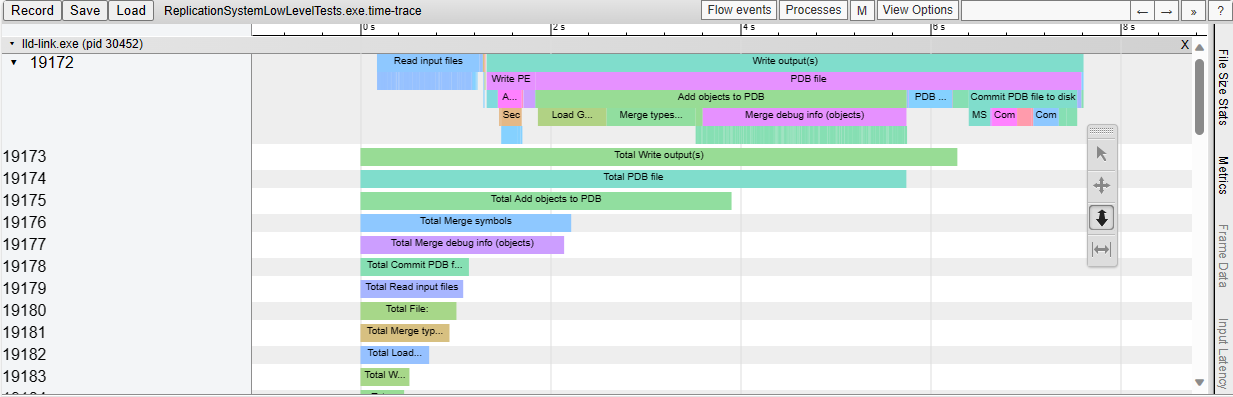
This adds support for generating Chrome-tracing .json profile traces in
the LLD COFF driver.
Also add the necessary time scopes, so that the profile trace shows in
great detail which tasks are executed.
As an example, this is what we see when linking a Unreal Engine
executable:
We are brining a new algorithm for function layout (reordering) based on the
call graph (extracted from a profile data). The algorithm is an improvement of
top of a known heuristic, C^3. It tries to co-locate hot and frequently executed
together functions in the resulting ordering. Unlike C^3, it explores a larger
search space and have an objective closely tied to the performance of
instruction and i-TLB caches. Hence, the name CDS = Cache-Directed Sort.
The algorithm can be used at the linking or post-linking (e.g., BOLT) stage.
Refer to https://reviews.llvm.org/D152834 for the actual implementation of the
reordering algorithm.

This diff adds a linker option to replace the existing C^3 heuristic with CDS.
The new behavior can be turned on by passing "--use-cache-directed-sort".
(the plan is to make it default in a next diff)

**Perf-impact**
clang-10 binary (built with LTO+AutoFDO/CSSPGO): wins on top of C^3 in [0.3%..0.8%]
rocksDB-8 binary (built with LTO+CSSPGO): wins on top of C^3 in [0.8%..1.5%]

Note that function layout affects the perf the most on older machines (with
smaller instruction/iTLB caches) and when huge pages are not enabled. The impact
on newer processors with huge pages enabled is likely neutral/minor.

Reviewed By: MaskRay

Differential Revision: https://reviews.llvm.org/D152840
Change the FF form --call-graph-profile-sort to --call-graph-profile-sort={none,hfsort}.
This will be extended to support llvm/lib/Transforms/Utils/CodeLayout.cpp.

--call-graph-profile-sort is not used in the wild but
--no-call-graph-profile-sort is (Chromium). Make --no-call-graph-profile-sort an
alias for --call-graph-profile-sort=none.

Reviewed By: rahmanl

Differential Revision: https://reviews.llvm.org/D159544
Close#57618: currently we align the end of PT_GNU_RELRO to a
common-page-size
boundary, but do not align the end of the associated PT_LOAD. This is
benign
when runtime_page_size >= common-page-size.
However, when runtime_page_size < common-page-size, it is possible that
`alignUp(end(PT_LOAD), page_size) < alignDown(end(PT_GNU_RELRO),
page_size)`.
In this case, rtld's mprotect call for PT_GNU_RELRO will apply to
unmapped
regions and lead to an error, e.g.
```
error while loading shared libraries: cannot apply additional memory protection after relocation: Cannot allocate memory
```
To fix the issue, add a padding section .relro_padding like mold, which
is contained in the PT_GNU_RELRO segment and the associated PT_LOAD
segment. The section also prevents strip from corrupting PT_LOAD program
headers.
.relro_padding has the largest `sortRank` among RELRO sections.
Therefore, it is naturally placed at the end of `PT_GNU_RELRO` segment
in the absence of `PHDRS`/`SECTIONS` commands.
In the presence of `SECTIONS` commands, we place .relro_padding
immediately before a symbol assignment using DATA_SEGMENT_RELRO_END (see
also https://reviews.llvm.org/D124656), if present.
DATA_SEGMENT_RELRO_END is changed to align to max-page-size instead of
common-page-size.
Some edge cases worth mentioning:
* ppc64-toc-addis-nop.s: when PHDRS is present, do not append
.relro_padding
* avoid-empty-program-headers.s: when the only RELRO section is .tbss,
it is not part of PT_LOAD segment, therefore we do not append
.relro_padding.
---
Close#65002: GNU ld from 2.39 onwards aligns the end of PT_GNU_RELRO to
a
max-page-size boundary (https://sourceware.org/PR28824) so that the last
page is
protected even if runtime_page_size > common-page-size.
In my opinion, losing protection for the last page when the runtime page
size is
larger than common-page-size is not really an issue. Double mapping a
page of up
to max-common-page for the protection could cause undesired VM waste.
Internally
we had users complaining about 2MiB max-page-size applying to shared
objects.
Therefore, the end of .relro_padding is padded to a common-page-size
boundary. Users who are really anxious can set common-page-size to match
their runtime page size.
---
17 tests need updating as there are lots of change detectors.
This adds a new -Bsymbolic option that directly binds all non-weak
symbols. There's a couple of reasons motivating this:
* The new flag will match the default behavior on Mach-O, so you can get
  consistent behavior across platforms.
* We have use cases for which making weak data preemptible is useful,
  but we don't want to pessimize access to non-weak data. (For a large
  internal app, we measured 2000+ data symbols whose accesses would be
  unnecessarily pessimized by `-Bsymbolic-functions`.)

Reviewed By: MaskRay

Differential Revision: https://reviews.llvm.org/D158322
This patch adds support to lld for --fat-lto-objects. We add a new
--fat-lto-objects option to LLD, and slightly change how it chooses input
files in the driver when the option is set.

Fat LTO objects contain both LTO compatible IR, as well as generated object
code. This allows users to defer the choice of whether to use LTO or not to
link-time. This is a feature available in GCC for some time, and makes the
existing -ffat-lto-objects option functional in the same way as GCC's.

If the --fat-lto-objects option is passed to LLD and the input files are fat
object files, then the linker will chose the LTO compatible bitcode sections
embedded within the fat object and link them together using LTO. Otherwise,
standard object file linking is done using the assembly section in the object
files.

The previous version of this patch had a missing `REQUIRES: x86` line in
`fatlto.invalid.s`. Additionally, it was reported that this patch caused
a test failure in `export-dynamic-symbols.s`, however,
29112a9946 disabled the
`export-dynamic-symbols.s` test on Windows due to a quotation difference
between platforms, unrelated to this patch.

Original RFC: https://discourse.llvm.org/t/rfc-ffat-lto-objects-support/63977

Reviewed By: MaskRay

Differential Revision: https://reviews.llvm.org/D146778
This adds support for the LoongArch ELF psABI v2.00 [1] relocation
model to LLD. The deprecated stack-machine-based psABI v1 relocs are not
supported.

The code is tested by successfully bootstrapping a Gentoo/LoongArch
stage3, complete with common GNU userland tools and both the LLVM and
GNU toolchains (GNU toolchain is present only for building glibc,
LLVM+Clang+LLD are used for the rest). Large programs like QEMU are
tested to work as well.

[1]: https://loongson.github.io/LoongArch-Documentation/LoongArch-ELF-ABI-EN.html

Reviewed By: MaskRay, SixWeining

Differential Revision: https://reviews.llvm.org/D138135
This reverts commit c9953d9891 and a
forward fix in 3a45b843de.

D14677 causes some failure on windows bots that the forward fix did not
address. Thus I'm reverting until the underlying cause can me triaged.
This patch adds support to lld for --fat-lto-objects. We add a new
--fat-lto-objects flag to LLD, and slightly change how it chooses input
files in the driver when the flag is set.

Fat LTO objects contain both LTO compatible IR, as well as generated object
code. This allows users to defer the choice of whether to use LTO or not to
link-time. This is a feature available in GCC for some time, and makes the
existing -ffat-lto-objects flag functional in the same way as GCC's.

If the --fat-lto-objects option is passed to LLD and the input files are fat
object files, then the linker will chose the LTO compatible bitcode sections
embedded within the fat object and link them together using LTO. Otherwise,
standard object file linking is done using the assembly section in the object
files.

Original RFC: https://discourse.llvm.org/t/rfc-ffat-lto-objects-support/63977

Depends on D146777

Reviewed By: MaskRay

Differential Revision: https://reviews.llvm.org/D146778
We want lld-link to automatically find compiler-rt's and
libc++ when it's in the same directory as the rest of the
toolchain. This is because on Windows linking isn't done
via the clang driver - but instead invoked directly.

This prepends: <llvm>/lib <llvm>/lib/clang/XX/lib and
<llvm>/lib/clang/XX/lib/windows automatically to the library
search paths.

Related to #63827

Differential Revision: https://reviews.llvm.org/D151188
This patch is spun out of https://reviews.llvm.org/D151188
and makes it possible for lld-link to find libraries with
relative paths. This will be used later to implement the
changes to autolinking runtimes explained in #63827

Differential Revision: https://reviews.llvm.org/D155268
Arm has BE8 big endian configuration called a byte-invariant(every byte has the same address on little and big-endian systems).

When in BE8 mode:
  1. Instructions are big-endian in relocatable objects but
     little-endian in executables and shared objects.
  2. Data is big-endian.
  3. The data encoding of the ELF file is ELFDATA2MSB.

To support BE8 without an ABI break for relocatable objects,the linker takes on the responsibility of changing the endianness of instructions. At a high level the only difference between BE32 and BE8 in the linker is that for BE8:
  1. The linker sets the flag EF_ARM_BE8 in the ELF header.
  2. The linker endian reverses the instructions, but not data.

This patch adds BE8 big endian support for Arm. To endian reverse the instructions we'll need access to the mapping symbols. Code sections can contain a mix of Arm, Thumb and literal data. We need to endian reverse Arm instructions as words, Thumb instructions
as half-words and ignore literal data.The only way to find these transitions precisely is by using mapping symbols. The instruction reversal will need to take place after relocation. For Arm BE8 code sections (Section has SHF_EXECINSTR flag ) we inserted a step after relocation to endian reverse the instructions. The implementation strategy i have used here is to write all sections BE32  including SyntheticSections then endian reverse all code in InputSections via mapping symbols.

Reviewed By: peter.smith

Differential Revision: https://reviews.llvm.org/D150870
This is an ongoing series of commits that are reformatting our
Python code. This catches the last of the python files to
reformat. Since they where so few I bunched them together.

Reformatting is done with `black`.

If you end up having problems merging this commit because you
have made changes to a python file, the best way to handle that
is to run git checkout --ours <yourfile> and then reformat it
with black.

If you run into any problems, post to discourse about it and
we will try to help.

RFC Thread below:

https://discourse.llvm.org/t/rfc-document-and-standardize-python-code-style

Reviewed By: jhenderson, #libc, Mordante, sivachandra

Differential Revision: https://reviews.llvm.org/D150784
--remap-inputs-file= can be specified multiple times, each naming a
remap file that contains `from-glob=to-file` lines or `#`-led comments.
('=' is used a separator a la -fdebug-prefix-map=)
--remap-inputs-file= can be used to:

* replace an input file. E.g. `"*/libz.so=exp/libz.so"` can replace a resolved
  `-lz` without updating the input file list or (if used) a response file.
  When debugging an application where a bug is isolated to one single
  input file, this option gives a convenient way to test fixes.
* remove an input file with `/dev/null` (changed to `NUL` on Windows), e.g.
  `"a.o=/dev/null"`. A build system may add unneeded dependencies.
  This option gives a convenient way to test the result removing some inputs.

`--remap-inputs=a.o=aa.o` can be specified to provide one pattern without using
an extra file.
(bash/zsh process substitution is handy for specifying a pattern without using
a remap file, e.g. `--remap-inputs-file=<(printf 'a.o=aa.o')`, but it may be
unavailable in some systems. An extra file can be inconvenient for a build
system.)

Exact patterns are tested before wildcard patterns. In case of a tie, the first
patterns wins. This is an implementation detail that users should not rely on.

Co-authored-by: Marco Elver <elver@google.com>
Link: https://discourse.llvm.org/t/rfc-support-exclude-inputs/70070

Reviewed By: melver, peter.smith

Differential Revision: https://reviews.llvm.org/D148859
Embedded systems that do not use an ELF loader locate the
.ARM.exidx exception table via linker defined __exidx_start and
__exidx_end rather than use the PT_ARM_EXIDX program header. This
means that some linker scripts such as the picolibc C library's
linker script, do not have the .ARM.exidx sections at offset 0 in
the OutputSection. For example:

.except_unordered : {
    . = ALIGN(8);
    PROVIDE(__exidx_start = .);
    *(.ARM.exidx*)
    PROVIDE(__exidx_end = .);
} >flash AT>flash :text

This is within the specification of Arm exception tables, and is
handled correctly by ld.bfd.

This patch has 2 parts. The first updates the writing of the data
of the .ARM.exidx SyntheticSection to account for a non-zero
OutputSection offset. The second part makes the PT_ARM_EXIDX program
header generation a special case so that it covers only the
SyntheticSection and not the parent OutputSection. While not strictly
necessary for programs locating the exception tables via the symbols
it may cause ELF utilities that locate the exception tables via
the PT_ARM_EXIDX program header to fail. This does not seem to be the
case for GNU and LLVM readelf which seems to look for the
SHT_ARM_EXIDX section.

Differential Revision: https://reviews.llvm.org/D148033
This implements support for relaxing these relocations to use the GP
register to compute addresses of globals in the .sdata and .sbss
sections.

This feature is off by default and must be enabled by passing
--relax-gp to the linker.

The GP register might not always be the "global pointer". It can
be used for other purposes. See discussion here
https://github.com/riscv-non-isa/riscv-elf-psabi-doc/pull/371

Reviewed By: MaskRay

Differential Revision: https://reviews.llvm.org/D143673
Previously by default, when not using `--ifc=`, lld would not
deduplicate string literals. This reveals reliance on undefined behavior
where string literal addresses are compared instead of using string
equality checks. While ideally you would be able to easily identify and
eliminate the reliance on this UB, this can be difficult, especially for
third party code, and increases the friction and risk of users migrating
to lld. This flips the default to deduplicate strings unless
`--no-deduplicate-strings` is passed, matching ld64's behavior.

Differential Revision: https://reviews.llvm.org/D140517
Currently we take the first SHT_RISCV_ATTRIBUTES (.riscv.attributes) as the
output. If we link an object without an extension with an object with the
extension, the output Tag_RISCV_arch may not contain the extension and some
tools like objdump -d will not decode the related instructions.

This patch implements
Tag_RISCV_stack_align/Tag_RISCV_arch/Tag_RISCV_unaligned_access merge as
specified by
https://github.com/riscv-non-isa/riscv-elf-psabi-doc/blob/master/riscv-elf.adoc#attributes

For the deprecated Tag_RISCV_priv_spec{,_minor,_revision}, dump the attribute to
the output iff all input agree on the value. This is different from GNU ld but
our simple approach should be ok for deprecated tags.

`RISCVAttributeParser::handler` currently warns about unknown tags. This
behavior is retained. In GNU ld arm, tags >= 64 (mod 128) are ignored with a
warning. If RISC-V ever wants to do something similar
(https://github.com/riscv-non-isa/riscv-elf-psabi-doc/issues/352), consider
documenting it in the psABI and changing RISCVAttributeParser.

Like GNU ld, zero value integer attributes and empty string attributes are not
dumped to the output.

Reviewed By: asb, kito-cheng

Differential Revision: https://reviews.llvm.org/D138550
Allowing incorrect version scripts is not a helpful default. Flip that
to help users find their bugs at build time rather than at run time.

Reviewed By: MaskRay

Differential Revision: https://reviews.llvm.org/D135402
