When reading the dynamic string table, llvm-objdump used to crash if the
ELF was malformed, due to an erroneous consumption of error status.
Instead, propogate the error status to the caller, fixing the crash, and
printing a warning.
-V prints the version information in both BSD and GNU ar/ranlib.
BSD ranlib rejects -v while -v enables verbose output in GNU ar but is
another alias for --version in GNU ranlib. The GNU ranlib behavior is
inconsistent: `ranlib -v` is different from `ar -sv`. But it's not a
major concern in practice:
* Users typically use ranlib solely for creating archive symbol tables,
and they don't need verbose output.
* Verbose output in ranlib seems a no-op.
* GNU ar creates an archive symbol table by default. Many ranlib uses
have been eliminated.
* Modern linkers like lld/ELF (since version 14) and mold don't rely on
archive symbol tables anymore.
https://reviews.llvm.org/D71554 introduced -v. This patch removes it so
that `llvm-ranlib -v` and `llvm-ranlib -version` lead to errors (GNU
ranlib rejects `-version` as well). -V is added as an alias for
--version.
Close#87654
Pull Request: https://github.com/llvm/llvm-project/pull/87661
--compress-sections is similar to --compress-debug-sections but applies
to arbitrary sections.

* `--compress-sections <section>=none`: decompress sections
* `--compress-sections <section>=[zlib|zstd]`: compress sections with zlib/zstd

Like `--remove-section`, the pattern is by default a glob, but a regex
when --regex is specified.

For `--remove-section` like options, `!` prevents matches and is not
dependent on ordering (see `ELF/wildcard-syntax.test`). Since
`--compress-sections a=zlib --compress-sections a=none` naturally allows
overriding, having an order-independent `!` would be confusing.
Therefore, `!` is disallowed.

Sections within a segment are effectively immutable. Report an error for
an attempt to (de)compress them. `SHF_ALLOC` sections in a relocatable
file can be compressed, but linkers usually reject them.

Link: https://discourse.llvm.org/t/rfc-compress-arbitrary-sections-with-ld-lld-compress-sections/71674

Pull Request: https://github.com/llvm/llvm-project/pull/85036
Reland #85231 after fixing build failure
https://lab.llvm.org/buildbot/#/builders/186/builds/15631.
Use `PRIx64` for format output of `uint64_t` as hex.
Original PR description below.

This adds support for `GNU_PROPERTY_AARCH64_FEATURE_PAUTH` feature (as
defined in https://github.com/ARM-software/abi-aa/pull/240) handling in
llvm-readobj and llvm-readelf. The following constants for supported
platforms are also introduced:

- `AARCH64_PAUTH_PLATFORM_INVALID = 0x0`
- `AARCH64_PAUTH_PLATFORM_BAREMETAL = 0x1`
- `AARCH64_PAUTH_PLATFORM_LLVM_LINUX = 0x10000002`

For the llvm_linux platform, output of the tools contains descriptions
of PAuth features which are enabled/disabled depending on the version
value. Version value bits correspond to the following `LangOptions`
defined in #85232:

- bit 0: `PointerAuthIntrinsics`;
- bit 1: `PointerAuthCalls`;
- bit 2: `PointerAuthReturns`;
- bit 3: `PointerAuthAuthTraps`;
- bit 4: `PointerAuthVTPtrAddressDiscrimination`;
- bit 5: `PointerAuthVTPtrTypeDiscrimination`;
- bit 6: `PointerAuthInitFini`.

Support for `.note.AARCH64-PAUTH-ABI-tag` is dropped since it's deleted
from the spec in ARM-software/abi-aa#250.
This is an extension to 07151f0241 which handled SandyBridge so we at least model the regression identified in #14640

Confirmed by Agner + uops.info/uica (SkylakeServer also had an incorrect use of Port015 instead of just Port01)

I raised #86669 as a proposal for a 'x86 unfold' pass that can unfold these (if we have the free registers) driven by the scheduler model.
Support generating dSYM companion files for (non-Darwin) firmware
environments by considering the binary component of the triple in
addition to the OS component.

rdar://125629792
This adds support for `GNU_PROPERTY_AARCH64_FEATURE_PAUTH` feature (as
defined in https://github.com/ARM-software/abi-aa/pull/240) handling in
llvm-readobj and llvm-readelf. The following constants for supported
platforms are also introduced:

- `AARCH64_PAUTH_PLATFORM_INVALID = 0x0`
- `AARCH64_PAUTH_PLATFORM_BAREMETAL = 0x1`
- `AARCH64_PAUTH_PLATFORM_LLVM_LINUX = 0x10000002`

For the llvm_linux platform, output of the tools contains descriptions
of PAuth features which are enabled/disabled depending on the version
value. Version value bits correspond to the following `LangOptions`
defined in #85232:

- bit 0: `PointerAuthIntrinsics`;
- bit 1: `PointerAuthCalls`;
- bit 2: `PointerAuthReturns`;
- bit 3: `PointerAuthAuthTraps`;
- bit 4: `PointerAuthVTPtrAddressDiscrimination`;
- bit 5: `PointerAuthVTPtrTypeDiscrimination`;
- bit 6: `PointerAuthInitFini`.

Support for `.note.AARCH64-PAUTH-ABI-tag` is dropped since it's deleted
from the spec in ARM-software/abi-aa#250.
(The profile format change is split into a standalone change into https://github.com/llvm/llvm-project/pull/81691)

* For InstrFDO value profiling, implement instrumentation and lowering for virtual table address.
* This is controlled by `-enable-vtable-value-profiling` and off by default.
* When the option is on, raw profiles will carry serialized `VTableProfData` structs and compressed vtables as payloads.

* Implement profile reader and writer support
  * Raw profile reader is used by `llvm-profdata` but not compiler. Raw profile reader will construct InstrProfSymtab with symbol names, and map profiled runtime address to vtable symbols.
  * Indexed profile reader is used by `llvm-profdata` and compiler. When initialized, the reader stores a pointer to the beginning of in-memory compressed vtable names and the length of string. When used in `llvm-profdata`, reader decompress the string to show symbols of a profiled site. When used in compiler, string decompression doesn't
happen since IR is used to construct InstrProfSymtab.
  * Indexed profile writer collects the list of vtable names, and stores that to index profiles.
  * Text profile reader and writer support are added but mostly follow the implementation for indirect-call value type.
* `llvm-profdata show -show-vtables <args> <profile>` is implemented.

rfc in
https://discourse.llvm.org/t/rfc-dynamic-type-profiling-and-optimizations-in-llvm/74600#pick-instrumentation-points-and-instrument-runtime-types-7
This pull request adds `MachineFunctionProperties` support. If a pass
wants to modify machine function properties, it must derive from
`MachinePassInfoMixin` and define some static methods like in legacy
pass manager. A test pass `RequireAllMachineFunctionPropertiesPass` is
also added here, which could be a example.
We check DAG.haveNoCommonBitsSet so the operands will be known to be
disjoint.

I couldn't think of a codegen test case since most targets aren't
checking hasDisjoint yet, apart from RISCV in the or_is_add pattern, but
it also falls back to computeKnownBits.
Add --skip-symbol and --skip-symbols options that allow to skip symbols
when executing other options that can change the symbol's name, binding
or visibility, similar to an existing option --keep-symbol that keeps a
symbol from being removed by other options.
This is compatible with MSVC, `-machine:arm64x` is essentially an alias
to `-machine:arm64ec`. To make a type library that exposes both native
and EC symbols, an additional `-defArm64Native` argument is needed in
both cases.
Defines a subset of attributes and emits them to a section called
.hexagon.attributes.

The current attributes recorded are the attributes needed by
llvm-objdump to automatically determine target features and eliminate
the need to manually pass features.
This is the major rename patch that prior patches have built towards.
The DPValue class is being renamed to DbgVariableRecord, which reflects
the updated terminology for the "final" implementation of the RemoveDI
feature. This is a pure string substitution + clang-format patch. The
only manual component of this patch was determining where to perform
these string substitutions: `DPValue` and `DPV` are almost exclusively
used for DbgRecords, *except* for:

- llvm/lib/target, where 'DP' is used to mean double-precision, and so
appears as part of .td files and in variable names. NB: There is a
single existing use of `DPValue` here that refers to debug info, which
I've manually updated.
- llvm/tools/gold, where 'LDPV' is used as a prefix for symbol
visibility enums.

Outside of these places, I've applied several basic string
substitutions, with the intent that they only affect DbgRecord-related
identifiers; I've checked them as I went through to verify this, with
reasonable confidence that there are no unintended changes that slipped
through the cracks. The substitutions applied are all case-sensitive,
and are applied in the order shown:

```
  DPValue -> DbgVariableRecord
  DPVal -> DbgVarRec
  DPV -> DVR
```

Following the previous rename patches, it should be the case that there
are no instances of any of these strings that are meant to refer to the
general case of DbgRecords, or anything other than the DPValue class.
The idea behind this patch is therefore that pure string substitution is
correct in all cases as long as these assumptions hold.
Remove support for obfuscated bitcode in dsymutil and the DWARF linker.
We no longer support bitcode submissions and the obfuscation support has
been removed from the rest of the compiler.

rdar://123863918
GNU readelf prints a blank line before the first hex/string dump, which
serves as a separator when there are other dump operations. Port the
behavior.

Pull Request: https://github.com/llvm/llvm-project/pull/85744
Remove support for obfuscated bitcode in dsymutil and the DWARF linker.
We no longer support bitcode submissions and the obfuscation support has
been removed from the rest of the compiler.

rdar://123863918
`macho-relative-method-lists.test` is failing on little endian
platforms, when matching 'name'.

```
CHK32-NEXT: name 0x144 (0x{{[0-9a-f]*}}) instance_method_00

next:10'0             X error: no match found
          18:  name 0x144 (0x7ac)
```
This seems like the obvious fix.

Co-authored-by: Alex B <alexborcan@meta.com>
Since some of the users of `CodeExtractor` like `HotColdSplitting` run
late in the pipeline, returns are not cleaned to `unreachable`. So,
just emit `unreachable` directly if the function is `noreturn`.
Closes#84682
This changs the way the assembly matcher works for Aarch32 parsing.
Previously there was a pile of hacks which dictated whether the CC,
CCOut, and VCC operands should be present which de-facto chose if the
wide/narrow (or thumb1/thumb2/arm) instruction version were chosen.

This meant much of the TableGen machinery present for the assembly
matching was effectively being bypassed and worked around.

This patch makes the CC and CCOut operands optional which allows the ASM
matcher operate as it was designed and means we can avoid doing some of
the hacks done previously. This also adds the option for the target to
allow the prioritizing the smaller instruction encodings as is required
for Aarch32.
As part of the WebAssembly support work review
  https://github.com/llvm/llvm-project/pull/82588

It was decided to rename:

  Files: LVElfReader.cpp[h] -> LVDWARFReader.cpp[h]
         ELFReaderTest.cpp  -> DWARFReaderTest.cpp

  Class: LVELFReader        -> LVDWARFReader

The name LVDWARFReader would match the another reader LVCodeViewReader
as they will reflect the type of
debug information format that they are parsing.
For Mach-O, ld64 supports the -fobjc-relative-method-lists flag which
changes the format in which method lists are generated. The format uses
delta encoding vs the original direct-pointer encoding.
This change adds support to llvm-objdump and llvm-otool for
decoding/dumping of method lists in the delta format. Previously, if a
binary with this information format was passed to the tooling, it would
output invalid information, trying to parse the delta lists as pointer
lists.
After this change, the tooling will output correct information if a
binary in this format is encountered.
The output format is closest feasible match to XCode 15.1's otool
output. Tests are included for both 32bit and 64bit binaries.
The code style was matched as close as possible to existing
implementation of parsing non-delta method lists.
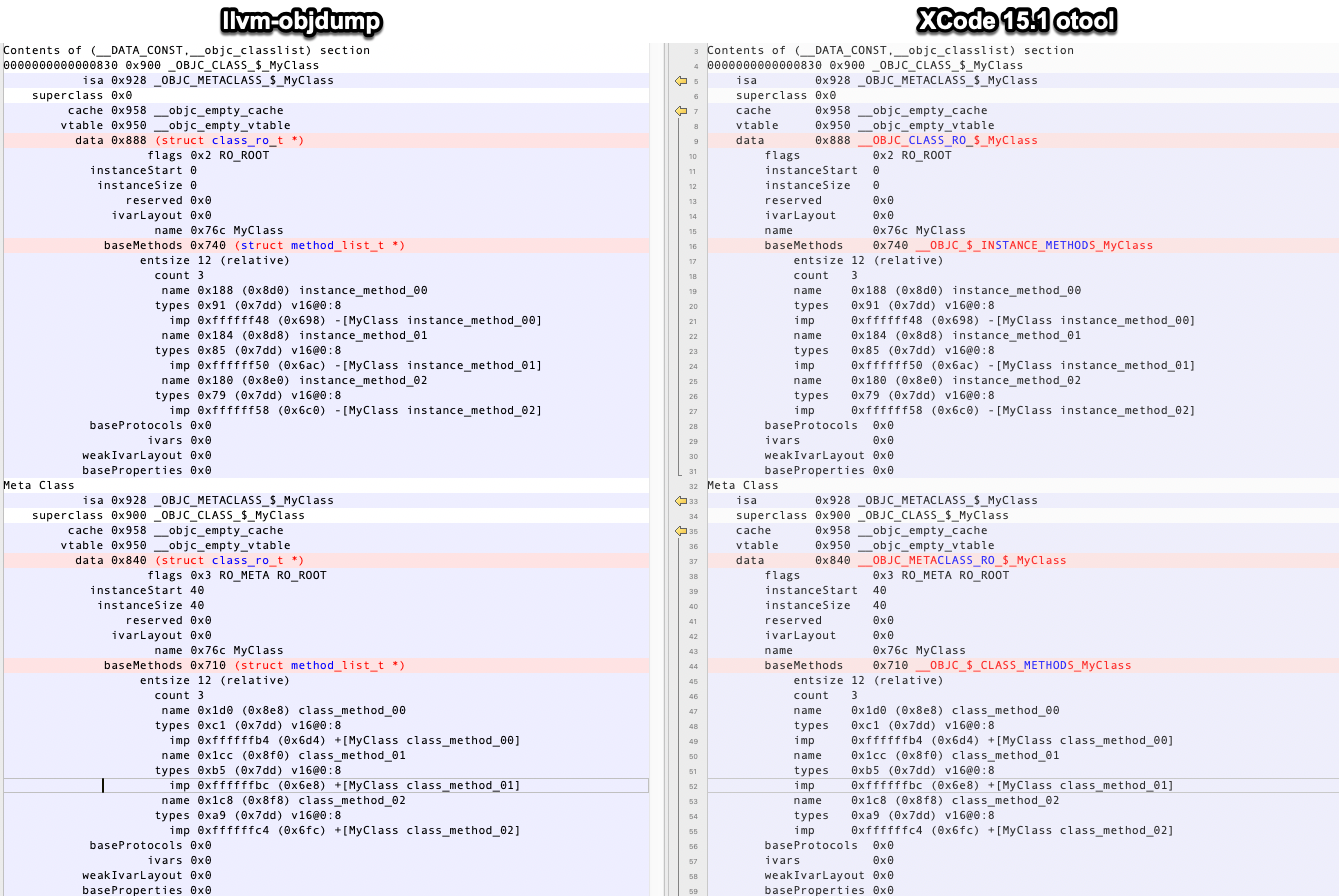
Diff between llvm-objdump and XCode 15.1 otool:

Note: This is a retry of this PR:
https://github.com/llvm/llvm-project/pull/84250
On the original PR, the armv7+armv8 builds were failing due to absolute
offsets being different.
Co-authored-by: Alex B <alexborcan@meta.com>
Intel Vtune/SEP has supported collecting LBR on Windows and generating
perf-script file which is same format as Linux perf script. This patch
teaches llvm-profgen to disassemble COFF binary so that we can do
Sampling based PGO on Windows.
For Mach-O, ld64 supports the `-fobjc-relative-method-lists` flag which
changes the format in which method lists are generated. The format uses
delta encoding vs the original direct-pointer encoding.
This change adds support to `llvm-objdump` and `llvm-otool` for
decoding/dumping of method lists in the delta format. Previously, if a
binary with this information format was passed to the tooling, it would
output invalid information, trying to parse the delta lists as pointer
lists.
After this change, the tooling will output correct information if a
binary in this format is encountered.
The output format is closest feasible match to XCode 15.1's otool
output. Tests are included for both 32bit and 64bit binaries.
The code style was matched as close as possible to existing
implementation of parsing non-delta method lists.
Diff between llvm-objdump and XCode 15.1 otool:
---------
Co-authored-by: Alex B <alexborcan@meta.com>
Add support for the WebAssembly binary format and be able to generate
logical views.

https://github.com/llvm/llvm-project/issues/69181

The README.txt includes information about how to build the test cases.
